Jun 16, 2025
I’ve started and abandoned blogging more often than I care to admit for someone who’s been obsessed with the written word (both consuming and creating) since childhood.
Somewhere along the line, I’ve let it get ingrained that there are two types of blogs, and only two types:
- The old-school personal blogs where you share your life
- Topic/niche blogs that advise or provide some sort of specific of value.
You’re also allowed to create a digital garden, but even then there are rules. You’re supposed to have bi-directional linking, and it’s more about a collection of knowledge than it is, “If I buy a broom, does that make me Laura Ingalls?”
I’ve all above the above and hit the same roadblock:
I want to go off topic.
I’ll start a personal blog with all these deep, introspective essays, but all of a sudden The 5 Best Task Managers for Minimalist MUST to be written. Or launch a tightly focused blog for romance authors, and wake up dying to write a PSA about the best Diptyque candle (Feu de Bois, obviously).
But I wanted to do it all. Listicles. Tips. Life advice. Writing advice. My tech set-up. Book reviews. recipes. Deep musings, and short proof of life updates. Notes to myself, notes to others. My thoughts on Top Gun 3.
I wanted to create a digital garden, a digital commonplace book, but also make room for personal musings and updates. To share a Milanote tutorial, an aesthetic mood board, the my thoughts on judging others, and maybe a picture of my sweet old dog, all in the same day.
I got in my head that This Was Not Allowed. That we’re supposed to be one thing and provide value for one group of people. The more specific the better. Not just “website tips,” but “Squarespace website tips for wellness coaches.” Above all, the focus was about your site visitor/followers. You work for them, so don’t you dare promise romance novel tips, but then try to sneak in an a post about how the Dyson Airstrait changed your hair-life.
The same feels true for social media, Substack, Etsy, YouTube…everywhere you look online, you’re supposed to be about something—one thing. Even lifestyle bloggers who are allowed more variety in their posting are supposed to have a thing: minimalism, travel, Nashville chic, #momoftwins.
It makes sense in theory, and maybe in practice too. Perhaps if you want to make money creating things for professional jugglers, you should limit your content to juggling.
But I can’t help but think we’ve lost something along the way. It’s like we’ve banished all things weird, random and varied from the Internet, unless, of course, your brand is weird and random.
What if by following these rules we’ve created a massive gap in the standards between offline living and online living?
Because in real life, analog life … in what world are the most interesting people the ones who only know and talk about one thing? Who wants to be at a dinner party when only one topic is allowed?
And yet that’s what we continue to demand of digital creators. Niche or nothing.
What if we opened up our social profiles, our Substacks, our blogs to the fact that we can be a businesswoman who shares banana bread recipes, a productivity expert with weirdly strong opinions on jazz bassists, or a nutritionalist who posts her watercolor landscapes.
Doesn’t that sound a lot more … interesting?
None of us are one thing—so why do we keep pretending to be online?
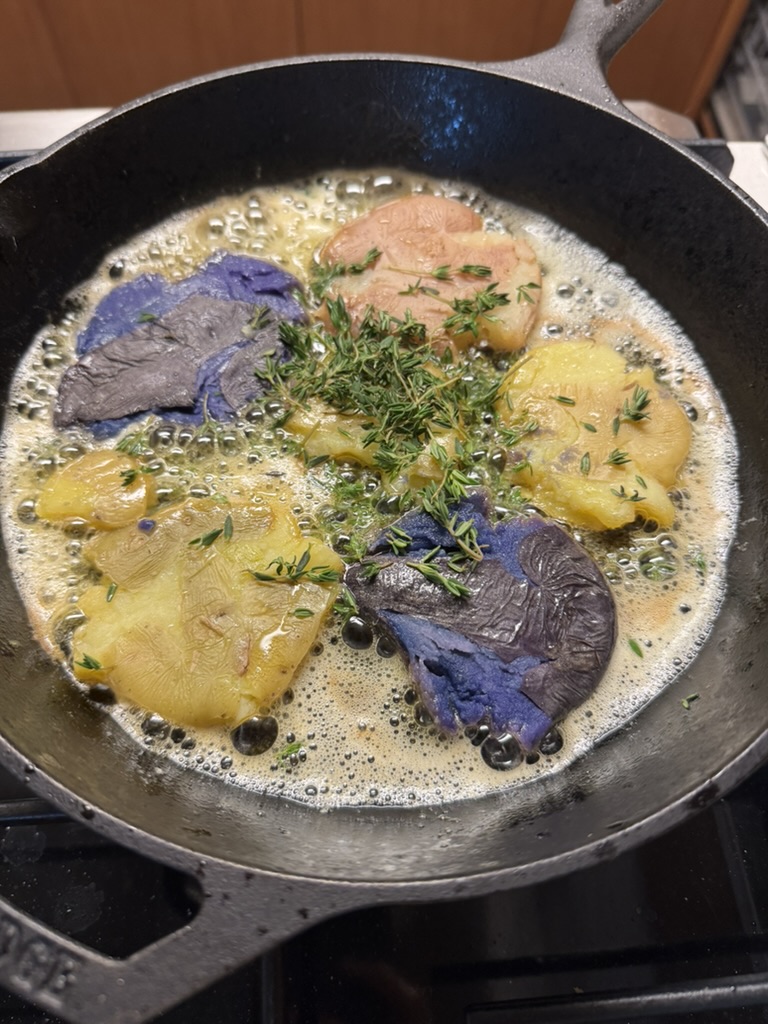
I will forever admire a master of one’s craft, but not if we sacrifice the weird, the tangents, and the fact that the most interesting bits of being human is how random it all is. How some days we’re wondering auras are real and the next day the most interesting thing that happened is that we ate a potato.
That’s what this blog is. A snapshot of being human, and all the inconsistent complexities that come with.
👇🏻 Potato.